Showing posts with label Blessed Mother Mary. Show all posts

Thursday, March 25, 2010

The Salvation of the World

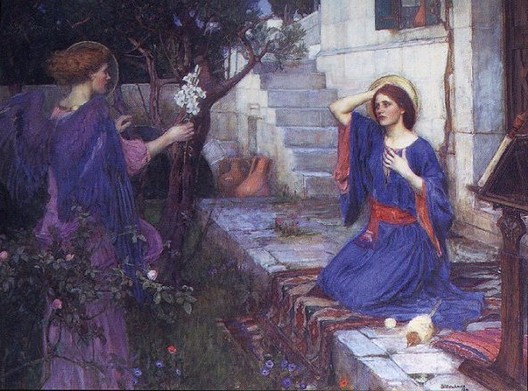
Today is a day I look forward to for two reasons, (don't you, too?)  First, today is The Feast of the Annunciation - the day when the Angel Gabriel came to a young girl named Mary and asked her to be the Mother of Our Lord, thus setting in motion the final steps to the salvation of the world.

The second reason is another celebration... a fictional one, I will admit, but a celebration non the less.  For today in Lord of the Rings history is the day that Sauron's Ring was destroyed, thus bringing about the salvation of Middle Earth.

As a devout Catholic and an avid Lord of the Rings fan, I am always overjoyed at how well these two loves go together.  Tolkien was a devout Catholic and this is very evident in his works.  But I'm sure you know that already, so I'll just cut to the quick and share with you some beautiful Catholic analogies (note, I said analogies, not allegories) and 'co-incidences' that I and my fellow Tolkien-fanatic friends have uncovered.

The Beginning of a New Year
This morning my dear friend, whom I shall call 'Flora Gamgee' gave me a call, first to wish me a Happy Annunciation, and secondly to bid me a Happy Destruction of the Ring Day.  During the course of our conversation, she told me that she just found out that in the traditional Catholic calendar, the liturgical year began today - March 25th, the Feast of the Annunciation.  Appropriate, since the Annunciation is when God's plan for our salvation was set in to play.
Now, Tolkien would have known about this fact and so I find it of great and exciting interest that he picked March 25th as the day the Ring would be destroyed.  From that day forth "in Gondor the New Year will always now begin upon the twenty-fifth of March when Sauron fell." - Return of the King

The Seven Sacraments
Back in January, I spent the night at another Tolkien-friends house and spent at least an hour and forty-five minutes discussing the Lord of the Rings.  (Oh, heaven!)  We could have talked longer... but decided that as it was about two in the morning we probably get at least some sleep - given the fact that we had to get up early the next... er, that morning.
"Well, I expect that I shall go on sleeping, whether I drop off or no.  And the less said the sooner I'll drop off, if you get my meaning." - Samwise Gamgee
The prevalent theme of our discussion was the analogies contained in the Lord of the Rings.  We are firm believers that there are no direct allegories, because Tolkien said so himself that he detested allegories.  However, I do believe and contend that there are many analogies - how could there not be, with such a devoted Catholic as the author? 
One of the allegories we discussed were the presence of the Seven Sacraments.  To tell the truth, we only found six, but we are sure the seventh is hiding in there somewhere.

Baptism
"Frodo heard the splash of water.  It foamed about his feet.  He felt the quick heave and surge as the horse left the river... He was across the Ford. ... 'By Elbereth and Luthien the Fair', said Frodo with a last effort, lifting up his sword, ' you shall have neither the Ring nor me!' ... the black horses were filled with madness, and leaping forward in terror they bore their riders into the rushing flood.  Their piercing cries were drowned in the roaring of the river as it carried them away." - The Fellowship of the Ring
  
For those who are not familiar with the Catholic Sacrament of Baptism, the candidate renounces Satan and all his evil works, is immersed in or has the water poured over his head and the black stains of Original Sin are washed away, in much the same way that Frodo rides through the river, tells the servants of Sauron to go away and the Black Riders being swept away by the flood.  (There are other actions involved - such as the anointing with oil and lighting the baptismal candle, but as they do not directly pertain to the analogy I am trying to demonstrate, I did not mention them.)


Confession 
"Aragorn knelt beside him.  Boromir opened his eyes and strove to speak.  At last slow words came. 'I tried to take the Ring from Frodo,' he said.  'I am sorry.  I have paid.'" - The Two Towers
 
This analogy is not quite as obvious in the books, but has a beautiful representation in the movies, particularly when Aragorn makes an almost Sign of the Cross-like gesture and blesses Boromir. (I am sure the filmmakers were quite unaware of any similarities.  But that makes it all the cooler!)  Boromir is dying after having tried to take the Ring from Frodo, and then defending Merry and Pippin from the orcs.  Aragorn finds him, and Boromir confesses to him what he has done.  As Aragorn consoles him, telling him that he is forgiven, Boromir dies.

Holy Communion
"Often in their hearts they thanked the Lady of Lórien for the gift of lembas, for they could eat of it and find new strength even as they ran." - The Two Towers
"The lembas had a virtue without which they would long ago have lain down to die.... it fed the will, and it gave strength to endure, and to master sinew and limb beyond the measure of mortal kind." - The Return of the King

As much has already been written on the similarities of the lembas bread and the Eucharist - it being the more obvious of the analogies -  I will not add my own interpretation here.  I will only say... wow.  Is that last quote amazing or what?

Confirmation
"'We have drunk the cup of parting," she said, 'and the shadows fall between us.  But before you go, I have brought in my ship gifts which the Lord and Lady of the Galadhrim now offer you in memory of Lothlorien.'" - The Fellowship of the Ring

This is another of the more hidden ones, but it is no less beautiful for it being hidden.  While Galadriel is not like a Bishop, or the Holy Spirit, she most certainly was inspired to give her gifts to the Fellowship.  Nine gifts, gifts that would strengthen and help each bearer in one way or another in their struggle against the evil of Sauron.

Matrimony
"And Aragorn the King Elessar wedded Arwen Undomiel in the City of the Kings upon the day of Midsummer, and the tale of their long waiting and labours was come to fulfillment."
And so it was settled.  Sam Gamgee married Rose Cotton in the Spring of 1420 (which was also famous for its weddings), and they came and lived at Bag End." - The Return of the King


I don't think I need to explain this one very much, do I? ;)  As we all know, Aragorn and Arwen, Faramir and Eowyn and Sam and Rosie were all married and all had long and beautiful lives together.

Holy Orders
Now I must confess that this is the Sacrament we are stumped on.  We are quite sure there is an analogy somewhere, but have not quite found it yet.  Any help?
Perhaps though... we are looking at this the wrong way... Read the later section titled "A Priest and a Deacon" and then give me your thoughts on the matter.

Anointing of the Sick
"So at last Faramir and Eowyn and Meriadoc were laid in beds in the Houses of Healing; and there they were tended well.
'The hands of the king are the hands of a healer.'" - The Return of the King

The Houses of Healing were a place in the city of Minas Tirith where those who were ill or dying were brought to be healed.  Many could be cured by ordinary means, but some required the special touch of the King.  It reminds me of how we often fall ill, but sometimes we need this sacrament, the healing of the King, to help us through our illness.  The beauty of it is that the Anointing of the Sick (formerly called 'The Last Rites') provides spiritual healing as well - just as Faramir and Eowyn were also healed of spiritual ailments in the Houses. 

A Priest and A Deacon
I cannot take credit for discovering either of the following analogies, having been informed myself by my friend Flora Gamgee and the other friend I mentioned who does not have a name.  Hmmm... I need to tell her to fix that.
While at the sleepover with my nameless friend, she mentioned that in ways Frodo was like a priest and Sam like a deacon.  Frodo had his specific task he was given, just as the priest has his.  Sam, as with the deacon, could not do Frodo's task for him - but he could help him to accomplish it.  Also, in case you never noticed, Frodo does not get married, just as a priest cannot, while Sam does.  (It is permissible for a deacon to be married, though technically they have to get married before they become a deacon.  Which is why these are analogies, not allegories.)

Finally, something that Flora pointed out to me that I found quite fascinating.  Before Frodo and Sam start their journey up Mount Doom (which has been likened to Christ's journey up Calvary) they eat the last bit of their food, they have their Last Supper.  As Frodo journey's up the mountain, bowed down with the weight of his burden, he stumbles and falls until at last he can go no further.  Then Sam helps by picking up Frodo and carrying him until he has the strength to go on.  (Simon of Cyrene, anyone?)

At that point the similarities stop, as Frodo gives in to the Ring's power.  But that is only natural.  Frodo was human - er, hobbit - and was able to give into temptation.  As I said before, that's why these are analogies and not allegories.  While some might discredit the imperfect fit of what I have just outlined, to me the fact that these incidents are not perfect fits, are not allegorical makes them that much more beautiful and fascinating.

So one these two special days - one Catholic, the other fictional - I hope I have given you something to ponder and marvel at the beauty of God's creation.  Thank you for bearing with me in my very long post.  =)

Nai haryuvalyë melwa rë!
(May you have a lovely day)
~ Silmarien

Tuesday, December 8, 2009

Feast of the Immaculate Conception!


Today celebrates the Immaculate Conception of the Blessed Virgin, as well as commemorates the day that Pope Pius IX pronounced and defined this doctrine.

"The Blessed Virgin Mary in the first instance of her conception, by a singular privilege and grace granted by God, in view of the merits of Jesus Christ, the Savior of the human race, was preserved exempt from all stain of original sin."

Mary, conceived without sin, pray for us who have recourse to thee!


Wednesday, October 7, 2009

The Feast of Our Lady of the Rosary

In honor of today being the Feast of Our Lady of the Rosary, I would like to share with you this article by Fr. William Saunders about the history of the Rosary.

The rosary is one of the most cherished prayers of our Catholic Church. Introduced by the Creed, the Our Father, three Hail Marys and the Doxology ("Glory Be"), and concluded with the Salve Regina, the rosary involves the recitation of five decades consisting of the Our Father, 10 Hail Marys and the Doxology. During this recitation, the individual meditates on the saving mysteries of our Lord's life and the faithful witness of our Blessed Mother.

Journeying through the Joyful, Sorrowful and Glorious mysteries of the rosary, the individual brings to mind our Lord's incarnation, His passion and death and His resurrection from the dead. In so doing, the rosary assists us in growing in a deeper appreciation of these mysteries, in uniting our life more closely to our Lord and in imploring His graced assistance to live the faith. We also ask for the prayers of our Blessed Mother, who leads all believers to her Son.

The origins of the rosary are "sketchy" at best. The use of "prayer beads" and the repeated recitation of prayers to aid in meditation stem from the earliest days of the Church and has roots in pre-Christian times. Evidence exists from the Middle Ages that strings of beads were used to count Our Fathers and Hail Marys. Actually, these strings of beads became known as "Paternosters," the Latin for "Our Father."

The structure of the rosary gradually evolved between the 12th and 15th centuries. Eventually 50 Hail Marys were recited and linked with verses of psalms or other phrases evoking the lives of Jesus and Mary. During this time, this prayer form became known as the rosarium ("rose garden"), actually a common term to designate a collection of similar material, such as an anthology of stories on the same subject or theme. During the 16th century, the structure of the five-decade rosary based on the three sets of mysteries prevailed.

Tradition does hold that St. Dominic (d. 1221) devised the rosary as we know it. Moved by a vision of our Blessed Mother, he preached the use of the rosary in his missionary work among the Albigensians, who had denied the mystery of Christ. Some scholars take exception to St. Dominic's role in forming the rosary. The earliest accounts of his life do not mention it, the Dominican constitutions do not link him with it and contemporaneous portraits do not include it as a symbol to identify the saint.

In 1922, Dom Louis Cougaud stated, "The various elements which enter into the composition of that Catholic devotion commonly called the rosary are the product of a long and gradual development which began before St. Dominic's time, which continued without his having any share in it, and which only attained its final shape several centuries after his death." However, other scholars would rebut that St. Dominic not so much "invented" the rosary as he preached its use to convert sinners and those who had strayed from the faith. Moreover, at least a dozen popes have mentioned St. Dominic's connection with the rosary, sanctioning his role as at least a "pious belief."

The rosary gained greater popularity in the 1500s, when Moslem Turks were ravaging Eastern Europe. Recall that in 1453, Constantinople had fallen to the Moslems, leaving the Balkans and Hungary open to conquest. With Moslems raiding even the coast of Italy, the control of the Mediterranean was now at stake.

In 1571, Pope Pius V organized a fleet under the command of Don Juan of Austria the half-brother of King Philip II of Spain. While preparations were underway, the Holy Father asked all of the faithful to say the rosary and implore our Blessed Mother's prayers, under the title Our Lady of Victory, that our Lord would grant victory to the Christians. Although the Moslem fleet outnumbered that of the Christians in both vessels and sailors, the forces were ready to meet in battle. The Christian flagship flew a blue banner depicting Christ crucified. On October 7, 1571, the Moslems were defeated at the Battle of Lepanto. The following year, Pope St. Pius V established the Feast of the Holy Rosary on October 7, where the faithful would not only remember this victory, but also give thanks to the Lord for all of His benefits and remember the powerful intercession of our Blessed Mother.

The fact that our Church continues to include the Feast of the Holy Rosary on the liturgical calendar testifies to the importance and goodness of this form of prayer. Archbishop Fulton Sheen said, "The rosary is the book of the blind, where souls see and there enact the greatest drama of love the world has ever known; it is the book of the simple, which initiates them into mysteries and knowledge more satisfying than the education of other men; it is the book of the aged, whose eyes close upon the shadow of this world, and open on the substance of the next. The power of the rosary is beyond description."

~ Courtesy of EWTN


Our Lady of the Rosary, Pray for us!


Tuesday, September 15, 2009

Feast of Our Lady of Sorrows


Litany of Our Lady of Seven Sorrows

by Pope Pius VII

V. Lord, have mercy on us.
R. Christ, have mercy on us.
V. Lord, have mercy on us. Christ, hear us.
R. Christ, graciously hear us.
God, the Father of heaven, have mercy on us.
God the Son, Redeemer of the world, have mercy on us.
God the Holy Spirit, have mercy on us.

Holy Mary, Mother of God, pray for us.
Holy Virgin of virgins, pray for us.
Mother of the Crucified, [etc.]
Sorrowful Mother
Mournful Mother
Sighing Mother
Afflicted Mother
Foresaken Mother
Desolate Mother
Mother most sad
Mother set around with anguish
Mother overwhelmed by grief
Mother transfixed by a sword
Mother crucified in thy heart
Mother bereaved of thy Son
Sighing Dove
Mother of Dolors
Fount of tears
Sea of bitterness
Field of tribulation
Mass of suffering
Mirror of patience
Rock of constancy
Remedy in perplexity
Joy of the afflicted
Ark of the desolate
Refuge of the abandoned
Shiled of the oppressed
Conqueror of the incredulous
Solace of the wretched
Medicine of the sick
Help of the faint
Strength of the weak
Protectress of those who fight
Haven of the shipwrecked
Calmer of tempests
Companion of the sorrowful
Retreat of those who groan
Terror of the treacherous
Standard-bearer of the Martyrs
Treasure of the Faithful
Light of Confessors
Pearl of Virgins
Comfort of Widows
Joy of all Saints
Queen of thy Servants
Holy Mary, who alone art unexampled

V. Pray for us, most Sorrowful Virgin,
R. That we may be made worthy of the promises of Christ.

Let us pray.

O God, in whose Passion, according to the prophecy of Simeon, a sword of grief pierced through the most sweet soul of Thy glorious Blessed Virgin Mother Mary: grant that we, who celebrate the memory of her Seven Sorrows, may obtain the happy effect of Thy Passion, Who lives and reigns world without end. Amen.

Tuesday, September 8, 2009

The Nativity of the Blessed Virgin Mary!


Happy Birthday, Mamma Mary!

Hail Mary, full of grace the Lord is with thee.
Blessed art thou amongst women, and blessed is the fruit of thy womb, Jesus.
Holy Mary, mother of God, pray for us sinners now and at the hour of our death.


With Love,

Saturday, June 20, 2009

Prayer to the Immaculate Heart of Mary


Prayer to the Immaculate Heart of Mary

Queen of the Most Holy Rosary, help of Christians, refuge of the human race, victorious in all the battles of God, we prostrate ourselves in supplication before thy throne, in the sure hope of obtaining mercy and of receiving grace and timely aid in our present calamities, not through any merits of our own, on which we do not rely, but only through the immense goodness of thy mother's heart. In thee and in thy Immaculate Heart, at this grave hour of human history, do we put our trust; to thee we consecrate ourselves, not only with all of Holy Church, which is the mystical body of thy Son Jesus, and which is suffering in so many of her members, being subjected to manifold tribulations and persecutions, but also with the whole world, torn by discords, agitated with hatred, the victim of its own iniquities. Be thou moved by the sight of such material and moral degradation, such sorrows, such anguish, so many tormented souls in danger of eternal loss! Do thou, O Mother of mercy, obtain for us from God a Christ-like reconciliation of the nations, as well as those graces which can convert the souls of men in an instant, those graces which prepare the way and make certain the long desired coming of peace on earth. O Queen of peace, pray for us, and grant peace unto the world in the truth, the justice, and the charity of Christ.

Above all, give us peace in our hearts, so that the kingdom of God may spread its borders in the tranquility of order. Accord thy protection to unbelievers and to all those who lie within the shadow of death; cause the Sun of Truth to rise upon them; may they be enabled to join with us in repeating before the Savior of the world: "Glory to God in the highest, and on earth peace to men of good will."

Give peace to the nations that are separated from us by error or discord, and in a special manner to those peoples who profess a singular devotion toward thee; bring them back to Christ's one fold, under the one true Shepherd. Obtain full freedom for the holy Church of God; defend her from her enemies; check the ever-increasing torrent of immorality, arouse in the faithful a love of purity, a practical Christian life, and an apostolic zeal, so that the multitude of those who serve God may increase in merit and in number.

Finally, even as the Church and all mankind were once consecrated to the Heart of thy Son Jesus, because He was for all those who put their hope in Him an inexhaustible source of victory and salvation, so in like manner do we consecrate ourselves forever to thee also and to thy Immaculate Heart, O Mother of us and Queen of the world; may thy love and patronage hasten the day when the kingdom of God shall be victorious and all the nations, at peace with God and with one another, shall call thee blessed and intone with thee, from the rising of the sun to its going down, the everlasting "Magnificat" of glory, of love, of gratitude to the Heart of Jesus, in which alone we can find truth, life, and peace.
Amen.

Sunday, May 31, 2009

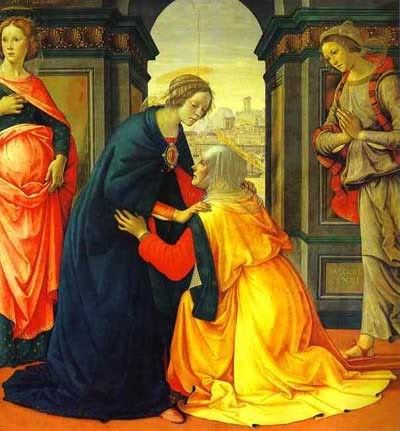
The Feast of the Visitation

feast of the visitation Pictures, Images and Photos


My soul magnifies the Lord,
And my spirit rejoices in God my Savior.
For He has regarded the low estate of His handmaiden,
For behold, henceforth all generations shall call me blessed.
For He who is mighty has done great things for me, and holy is His name. And His mercy is on those who fear Him from generation to generation.
He has shown strength with His arm:
He has scattered the proud in the imagination of their hearts.
He has put down the mighty from their thrones,
and exalted those of low degree.
He has filled the hungry with good things;
and the rich He has sent empty away.
He has helped His servant Israel, in remembrance of His mercy;
As He spoke to our fathers, to Abraham and to His posterity forever.

Glory be to the Father and to the Son and to the Holy Spirit.
As it was in the beginning, is now and ever shall be, world without end. Amen

Scripture text: Revised Standard Version - Catholic Edition

Quote of the May


Blessed are the actions enclosed between two Hail Marys.
***
Know that of all devotions the most pleasing to Mary
is to have frequent recourse to her, asking her favors.
***
Let the servants of Mary perform every day, and especially on Saturday,
some work of charity for her sake.
***
When the devil wishes to make himself master of a soul,
he seeks to make it give up devotion to Mary.
St. Alphonsus

Friday, May 29, 2009

Quote of the May

You, O mary, are the young plant that produced the fragrant flower of the Word, only begotten of God, because you were the fertile land that was sown with this Word.
~ Saint Catherine of Siena

Wednesday, May 27, 2009

Quote of the May

Remember me, dearest Mother, and do not abandon me at the hour of death.
~ Saint Francis de Sales

Tuesday, May 26, 2009

Quote of the May

In all temptations of pride, there is no greater remedy than this one: to have recourse to the humble Jesus and Mary
~ Saint Alphonsus Rodriquez

Monday, May 25, 2009

Quote of the May

We turn to you for protection, holy Mother of God.
Listen to our prayers and help us in our needs.
Save us from every danger, glorious and blessed Virgin.

~ Sub tuum Praesidium, oldest known prayer to Mary, circa 300

Saturday, May 23, 2009

Quote of the May

The moon illuminates the night when the sun has set and before the next sunrise; Mary, too, often illuminates those who are in the night of faith and being tested... if they invoke her.
~ Raniero Cantalamessa, OFM Cap

Thursday, May 21, 2009

Quote of the May

Christ was born of a virgin and took His flesh from her, as was His will, in accord with the economy of salvation... Thus, the virign became the Mother of God.
~ Saint Proclus of Constantinople

Tuesday, May 19, 2009

Quote of the May

To recite the Rosary is nothing other than to contemplate with Mary the face of Christ.
~ Pope John Paul II

Monday, May 18, 2009

Quote of the May

There is no more excellent way to obtain graces from God than to seek them through Mary, because her divine Son cannot refuse her anything.
~ Saint Philip Neri

Sunday, May 17, 2009

Quote of the May

"We never give more honour to Jesus than when we honour his Mother, and we honour her simply and solely to honour him all the more perfectly. We go to her only as a way leading to the goal we seek - Jesus, her Son."
-Saint Louis Marie de Montfort

Friday, May 15, 2009

Quote of the May

Mary stands in the presence of her Son, and never ceases to intercede for sinners.
~ Saint Bede the Venerable

Thursday, May 14, 2009

Quote of the May

There is no more excellent way to obtain graces from God than to seek them through Mary, because her divine Son cannot refuse her anything.
~ Saint Philip Neri

Wednesday, May 13, 2009

The Modesty Mall - The Why, What and How of Modesty

Yes, modesty-mall.com is here!

For those of you who may have missed the note i posted a while back or are new and have no idea what i am talking about, i shall explain. =) (Nice of me, isn't it?)

Beginning last fall when i signed up with SiteSell.com i have been working like a tortoise (that's a good thing) on my very own website about modesty. My site will be geared mainly towards teens, Catholic teens to be specific, but it is my hope that both the young and the young at heart, Catholics and non-Catholics will be able to visit and get something out of it.

Here is a small excerpt from the homepage

Sorry. Oh, and what's with the whole Modesty Mall thing? What's that supposed to mean?

It's pretty simple really. In the dictionary, a mall is defined as 'a usually large suburban building or group of buildings containing various shops with associated passageways'. There are a whole bunch of different kinds of shops in a mall, right? Clothing stores, book stores, music stores, etc. Well, this website is kind of like a mall. Think of the different pages as shops and stores with the links as your... read the rest here


Remembering the messages of Our Lady of Fatima and her warnings that "certain fashions shall be introduced which will offend Our Lord very much", if find it no coincidence that my website was ready to be launched on today, Our Lady's feast day. While it was unplanned on my part, i know it was planned by Someone else! ;)

So i now dedicate my website, modesty-mall.com, my work and my efforts to Our Lady of Fatima. I ask Our Lady that she will bless them, and i ask all of you that you will occaisonally petition Our Lady of Fatima on my behalf. Thank you!